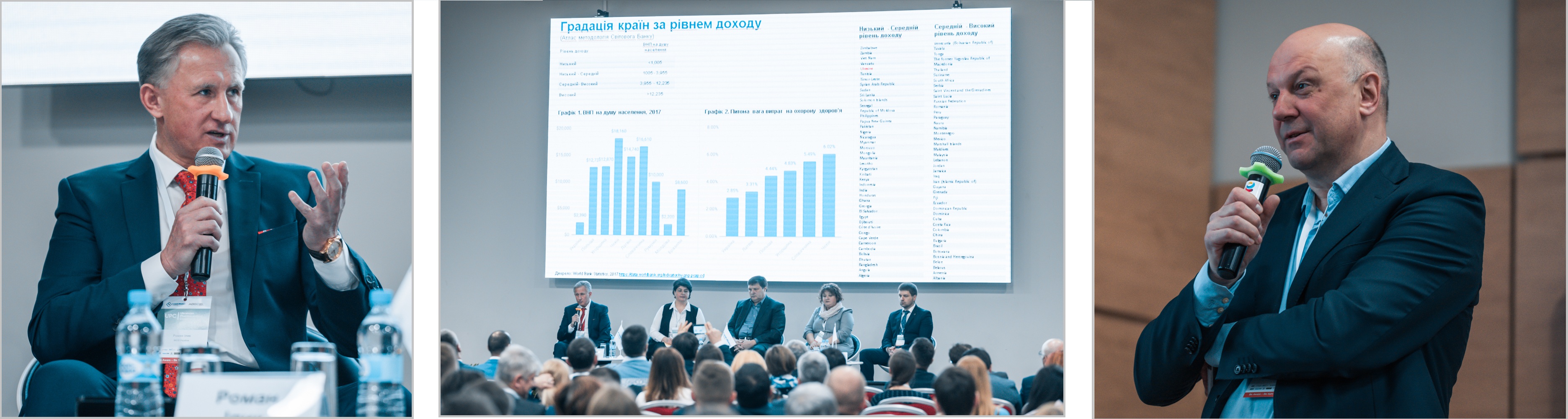
The medical reform and its influence on the pharmaceutical industry and prospects of the market development were discussed at the conference Ukrainian Pharmaceutical Congress 2019 which took place in Kiev on March 14th, 2019. The congress was attended by leading experts in the pharmaceutical and legal support sectors, top managers of leading national and foreign pharmaceutical companies, representatives of medical facilities and state medical authorities, and members of Parliament. The participants worked in 6 panels, each of which rose topical issues of the pharmaceutical industry development.
Panel 1. Medical reform and its prospects
Pros and cons of the medical reform were discussed by:
- Iryna Sysoenko – People’s Deputy, Deputy Head of the Healthcare Committee of the Verkhovna Rada;
- Oleksandr Zhyhinas – Counsel of the Minister of Health of Ukraine, Executive Advisor of the National Healthcare Service of Ukraine;
- Mykhailo Radutskyi – President of Borys clinic, freelance advisor of the mayor of Kyiv;
- Dmytro Aleshko – partner at Legal Alliance Company, co-moderator;
- Maryna Buchma – Director for PR with state authorities at Teva Ukraine, co-moderator.
Main messages:
- this year ended automatization of medical facilities where medical establishments were able to reorganize themselves on preferential basis. Currently draft law No. 9075 has been submitted to the Parliament. It must extend for another year the simplified procedure for reorganizing facilities into communal non-profit enterprises;
- Iryna Sysoenko, People’s Deputy, Deputy Head of the Healthcare Committee of the Verkhovna Rada talked about insurance of medical liability and professional activities of doctors and healthcare professionals. The matter is, in particular, absence of definition of medical doctor’s mistake in legislation. The register of doctor’s mistakes must appear in Ukraine, and professional liability of doctors must be insured to be able to separate medical mistake from negligence as it works in European countries;
- since for the time being all liability is on legal entities, and protection of patient rights in Ukraine is not ensured, individual doctor licensing will be a right step ahead in domestic medicine;
- electronic prescription is one of the novelties actively discussed at the congress. Its advantage is that the patients participating in the program “Affordable Medicines” will be able to get a new prescription from their doctor online. However, the issue of allocation of budget funds to prescriptions in order to cover expenses in equal installments during a month remains unsolved. State authorities officers ensure that this problem will be solved.
- pharmacies to be able to issue medicines on electronic prescriptions, according to Olexandr Zhyginas, Counsel of the Minister of Health of Ukraine, have to submit an application and register in the electronic healthcare system by March 25th, 2019. The agreements will become effective as soon as April 1st, 2019. “According to the reports, payments to pharmacies under these agreements will be made twice a month, on 1st and 16th days of the current month”, he explained.

Panel 2.Pharmaceutical regulation
The discussion on medicine price regulation and program “Affordable Medicines” and its condition was attended by:
- Roman Ilyk – Deputy Minister of Health of Ukraine;
- Vladyslav Tsilyna – First Deputy Head of the State Service of Ukraine on Medicines and Drugs Control;
- Tetiana Dumenko – Director of the State Expert Centre at the Ministry of Health of Ukraine;
- Oleksandra Oleshchuk – Head of the Expert Committee for Selection and Use of Essential Medicines;
- Pavlo Kharchyk – President of AMOMD;
- Dmytro Aleshko – partner at Legal Alliance Company, co-moderator;
- Mykhailo Pasichnyk – President of Public Association “Pharmaceutical League of Ukraine”, co-moderator.
Main messages:
- in Ukraine 427 INN based on which medicines will be procured have been included to the National List. From them 23 INN have been included to the program “Affordable Medicines”;
- one of priority tasks of the Ministry of Health is combating antibiotic resistance. “Due to antibiotic resistance people die not only in Ukraine, but worldwide. Generally, uncontrolled access to antibiotics is related to the problem of self-treatment, irresponsible treatment. According to the WHO data, 64% of people mistakenly believe that antibiotics can treat those diseases where they would not have to be used. Therefore, this is the problem requiring comprehensive solution”, Roman Ilyk, Deputy Minister of Health, stated. According to Mr. Ilyk, for the time being realization of antibiotics based on prescription is legally governed in Ukraine, however the Ministry of Health will insist on more severe liability for realization of prescription medicines without prescription;
- significant achievement in the medical sector is cancellation of maximum 10% mark-up on medicines (including equipment) procured for budget funds. According to participants of the discussion, “this draft has been worked on for almost 7 years. Its approval has become a weighty step ahead which will enable manufacturers to take part in tenders competitively”.
Panel 3. Promotion and compliance
Protection of personal data and creative compliance approaches to development of business were talked about by:
- Oleksandr Melianchuk – Head of Legal Department of Roche Ukraine;
- Kshyshtof Sedletski – senior partner at ABSC;
- Illya Kostin – partner at Legal Alliance Company;
- Taras Bezpalyi – counsel at Legal Alliance Company;
- Oleksii Bezhevets – partner at Legal Alliance Company, moderator.
Main messages
- weight of compliance (compliance with business ethics, external and internal requirements or legal norms) is constantly increasing in the Ukrainian pharmaceutical market governance and strategy of pharmaceutical companies’ business development;
- successful compliance management system should consist, in particular, of the following elements: corporate culture, care of positive reputation, standards and control, risk monitoring and assessment, training and communication;
- personal data protection issue becomes critical, including in view of GDRP application;
- pharmaceutical companies will not avoid changes in regulation of international transaction taxation, transfer pricing, new requirements to work with law-tax jurisdictions and BEPS rules. Changes in work should be planned and implemented.
- use by pharmaceutical companies in collaboration with NGO can be quite effective mechanism of business development, provided compliance requirements are met.

Panel 4. Competition at pharmaceutical market
Business safety at the pharmaceutical market was discussed by:
- Olena Shevchuk – Deputy Director of the Department for Investigation of Violations of Legislation on Economic Competition Protection of the AMCU;
- Iryna Golovkova – Director for Legal Matters and Compliance in Ukraine and CIS of ACINO in Ukraine;
- Volodymyr Igantov – Executive Director of AIPM, CEO of Representative Office of IPSEN Pharma in Ukraine and Moldova;
- Andrii Gorbatenko – partner at Legal Alliance Company;
- Vitalii Gordiienko – Head of the Board of Directors of APRAD, Director of AbbVie in Ukraine, moderator.
Main messages:
- to enable the pharmaceutical market to work more effectively for both business and consumer, the AMCU offered a system to stimulate competition on the pharmaceutical market. “This is somehow a set of “road signs” for every participant of the pharmaceutical market to learn, read and follow knowing certain rules of game”, noted Olena Shevckuk, representative of the AMCU. According to her words, each market player can apply to the committee for individual explanation, if needed, since “the pharmaceutical market is specific and diverse, therefore it is quite hard to ensure unified approach for all”;
- representatives of the pharmaceutical business stated that they “want to play in the legal field”, and determination of certain rules is quite important for them. They underlined: since the system changes every time, they cannot completely understand in which legal field they are. Further, according to their words, a lot of conflicts arise due to inconsistent market regulation.
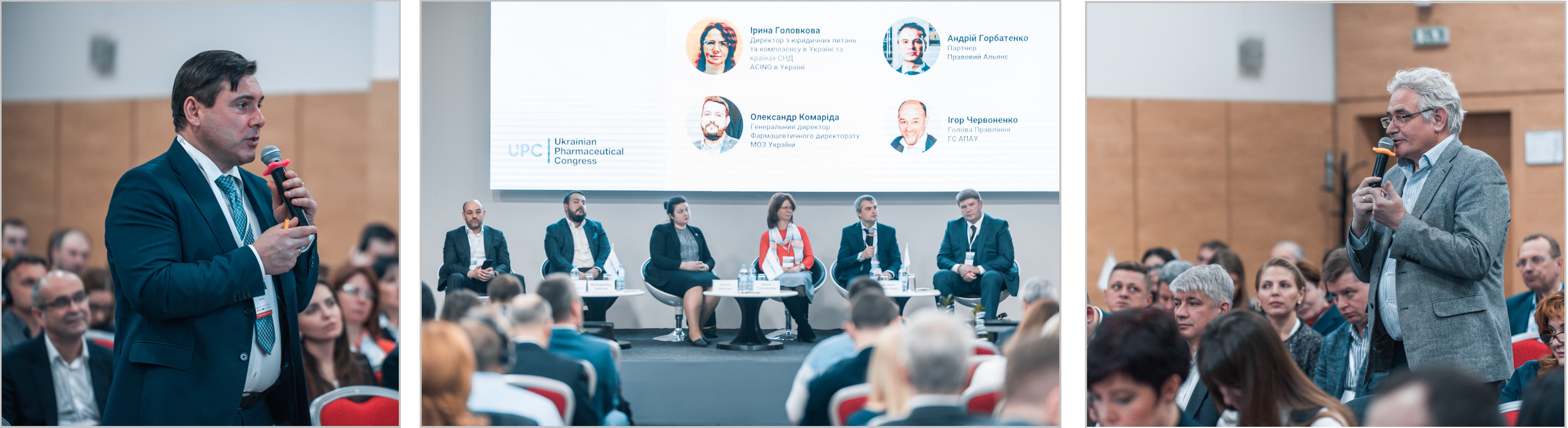
Panel 5. Pharma in the healthcare reform – opportunity or threat?
Pharma in the healthcare reform was discussed by:
- Pavlo Kovtoniuk – Deputy Minister of Health of Ukraine;
- Dmytro Shymkiv – Head of the Board of Darnytsia managing company;
- Koki Sato – CEO at Takeda Ukraine;
- Sergii Ishchenko – CEO at Proxima Research;
- Nataliia Sergiienko – CEO of the Healthcare Committee of the European Business Association, co-moderator;
- Kshyshtof Sedletski – senior partner at ABSC, co-moderator.
Main messages:
- “Now state provides only 12% of the medicines needed by the population. Last year cost of medicines consumed at the pharmaceutical market of Ukraine was UAS 3.1. billion, which is 0.26% of the world consumption. The Ukrainian pharmaceutical market considerably outstrips the world market in the growth speed. For today the market growth showed +21.5% in the national currency and +4.5% in kind”, mentioned Sergii Ishchenko, CEO at Proxima Research
- “Having a tariff for treatment, a hospital will be interested in procuring more cheapermedicines”, said Pavlo Kovtoniuk, Deputy Minister of Health of Ukraine. He has also noted that limited budget requires more pragmatism and setting priorities;
- Dmytro Shymkiv, Head of the Board of Darnytsia managing company, underlined importance of Ukrainian pharmaceutical companies in providing access to treatment for citizens and outlined prospects of increasing weight of domestic manufacturers on the pharmaceutical market;
- Koki Sato, CEO at Takeda Ukraine, stated that leading global pharmaceutical companies are ready to collaborate with the government to create conditions which would enable Ukrainians to access innovative medicines;
- All participants stressed on importance of the dialogue, necessity of it and will to hold it between state authorities and market participants.

Panel 6. Manager’s career: new challenges and opportunities
Experience of managing successful companies has been shared by:
- Evgen Zaika – CEO at ACINO in Ukraine, Regional Director of ACINO in CIS countries;
- Andrii Samoilovych – CEO at Sandoz Ukraine;
- Tetiana Lukyniuk – CEO at Redbull in Ukraine and Belorus;
- Victor Yakovenko – partner at Ward Howell, moderator.
Main messages:
- qualities a CEO needs: discipline, readiness to made decisions alone and be responsible for them, versatility, ability to see the whole picture, communicability;
- the top-managers listed among their reasons for success the following – ability to make decisions in time and make a right choice.

Timely and correct reaction to current changes is important to reform the healthcare sector. The congress participants got acquainted with the latest tendencies in the industry development which influence successful operation of pharmaceutical companies in Ukraine, as well as improvement of business effectiveness.