Interfax-Ukraine, 28th of October, 2019.
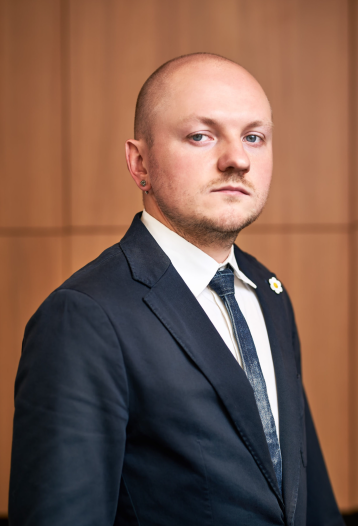
Vitaliy Savchuk, counsel, attorney-at-law, Legal Alliance Company.
The bill on changing approaches to patenting inventions and utility models will not increase the availability of medicines for the population, said Vitalii Savchuk, counsel at Legal Alliance Company.
Commenting to the Interfax-Ukraine agency on the bill on amending certain legislative acts to increase the availability of medicines for the population (No. 2089), Mr. Savchuk noted that if the bill is adopted in the long term, it can lead to a result that is directly opposite to the declared goal. The “approach” to take and share “will not work in pharmaceuticals,” he said.
The lawyer explained that based on the idea that “the human right to health should prevail over the intellectual property right”, the authors of the bill propose to ban patent protection for the entire groups of objects, including new dosages, any new property, new use of a well-known drug, utility models that relate to medicines. It is also proposed not to recognize as new any new property or new use of the medicinal product. According to Mr. Savchuk, this could "severely limit the patent capabilities of individual players in the market."
In addition, he noted that the bill proposes not to consider the use of the invention in preparation for state registration of a medicinal product as a violation of the rights of the patent holder.
“In general, the authors' positive suggestions lack specificity, which can lead to abuse,” the lawyer explained.
Mr. Savchuk also drew attention to the fact that the bill proposes to allow parallel import of medicines without regulating their quality control and the responsibility of such an importer.
"All over the world, the law is inherently indifferent to the noble goals of limiting patent protection, but attentive to the reasons. This means that the state should not be guided only by the ideas of a situational public interest, it should be guided by the law, and the law, in turn, should be(ideally) designed so that the public interest is constantly taken into account," he said.
Mr. Savchuk noted that for the investments, efforts and the risks associated with the development of new technologies, the owner of a patent to an invention receives a reward - a 20-year monopoly on its use in the market. Moreover, any invention must meet the criteria - novelty, inventive step, industrial applicability. If at least one of them is not not met, protection is not granted to the invention.
"The access of more patients to medicines can only be a consequence, not a reason for the lack of patent protection. If the reason is confused with the consequence, most patents can be safely neglected - as a rule, it is easy to put a more affordable product on the market a few years after the patent is published," - explains the lawyer.
According to him, in the short term, it may seem that consumers will benefit from this. “But manufacturers of original drugs lose their motivation to invest time and money in developing new technologies. Thus, in the long run, patients have the risk of slowing down development in the industry, which means they will be left without even better medicines,” said Mr. Savchuk.
He stressed that such a problem is not only Ukrainian and is not limited to the pharmaceutical industry. In the world, for example, there is the problem of "evergreen patents" and the applicant's obtaining a new patent for a known technology due to minor modifications.
According to Savchuk, "in this case there is no other way to determine the fairness of a monopoly than checking in court each individual invention for compliance with the criteria."
"One cannot say unequivocally that patent protection restricts patients' access to medicines. The law allows judicial review of this statement in each case. It is obvious that the balance of business and consumer interests is important and probably not fully achievable, but this does not mean that you don’t even need to try to achieve it," he concluded.
As reported, deputies Olga Stefanishina and Olexandra Ustinova (both “Golos”) have registered Bill No. 2089, which, in particular, proposes the implementation of a number of provisions and EU directives on the legal protection of biotechnological inventions and medical products in national legislation.
The authors of the bill believe that improving approaches to patenting inventions and utility models will create prerequisites for enhancing inventive activity, encourage the presence on the market of innovative medicines in Ukraine, and increase the effectiveness of patent protection in the pharmaceutical field as a whole.
The bill also introduces the possibility of parallel importation of medicines and proposes to resolve the current dependancy between the registration of medicines and patent rights.






The event focused on the transformation of Ukraine's intellectual property sector on its path toward European integration.
Improving access to safe and affordable medicines for the Ukrainian population is one of the Government of Ukraine's top priorities. SAFEMed Activity (2017-2025) has supported this effort by appIying health system strengthening best practices.
The Ministry of Health website has posted a notice about the release of a revised draft order of the Ministry of Health ‘On Approval of Amendments to Certain Re
On 25 September, a webinar was held on the topic: ‘180 days of new drug price regulation. Results, prospects and practical advice.’ The event was organized by LA Law Firm in partnership with Proxima Research International.
